
Epidemiology of influenza before, during, and after the COVID-19 pandemic in China: An observational study from Zhejiang, China (2010–2023)
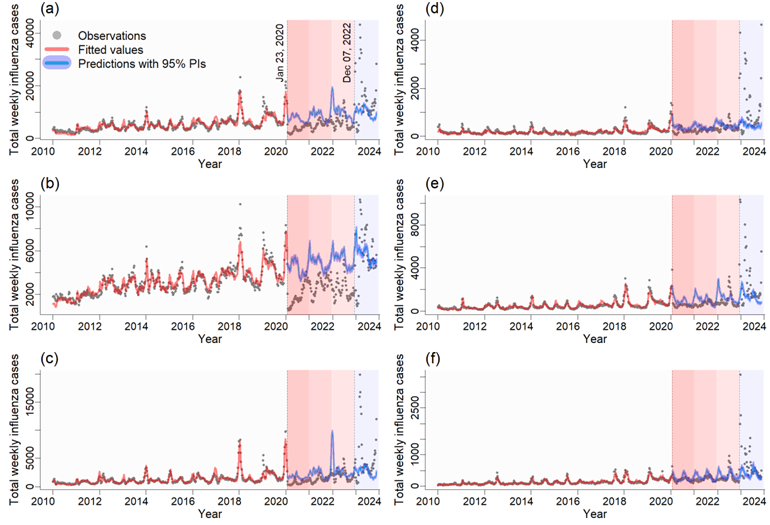
The epidemiology of influenza has shifted markedly in recent years due to COVID-19 social restrictions. However, it remains unclear whether these findings apply to China, where a Zero-COVID policy was implemented. We evaluated influenza trends in Zhejiang Province, China from 2010–2023 — before, during, and after the strict policy. Using 4,295,302 influenza diagnoses from weekly surveillance data, we applied change-point detection and interrupted time-series models to quantify policy impacts by comparing predicted and observed influenza cases based on absolute and percentage changes across four phases. Individual-level data (2017–2023; N = 24,165) were examined for lineage and demographic changes. During the Zero-COVID policy, observed cases dropped significantly — by 184,998 in 2020 (–104%; 95% prediction interval [PI]: –110 to –99), 190,176 in 2021 (–67%; –71 to –62), and 179,913 in 2022 (–60%; –64 to –56). Following policy relaxation in 2023, cases exceeded expectations by 255,008 (+34%; 32 to 36), while infections among children under five still declined by 9,742 (–3.6%; –7.1 to –0.1). The B/Victoria lineage dominated early in the pandemic (>99% in 2021), while A/H3 (55%) and A/H1 (41%) prevailed by 2023. The Zero-COVID policy profoundly disrupted influenza dynamics, with widespread rebounds after relaxation except among young children. Evolutionary competition among lineages intensified during and after restrictions, with uncertain long-term implications.
 |
Recommended citation: Chen Y, Luo F, Ling F, et al. (2025). "Epidemiology of influenza before, during, and after the COVID-19 pandemic in China: An observational study from Zhejiang, China (2010–2023)." Second-round revision.