
Estimating semiparametric models for spatiotemporal data with complex dependence structures
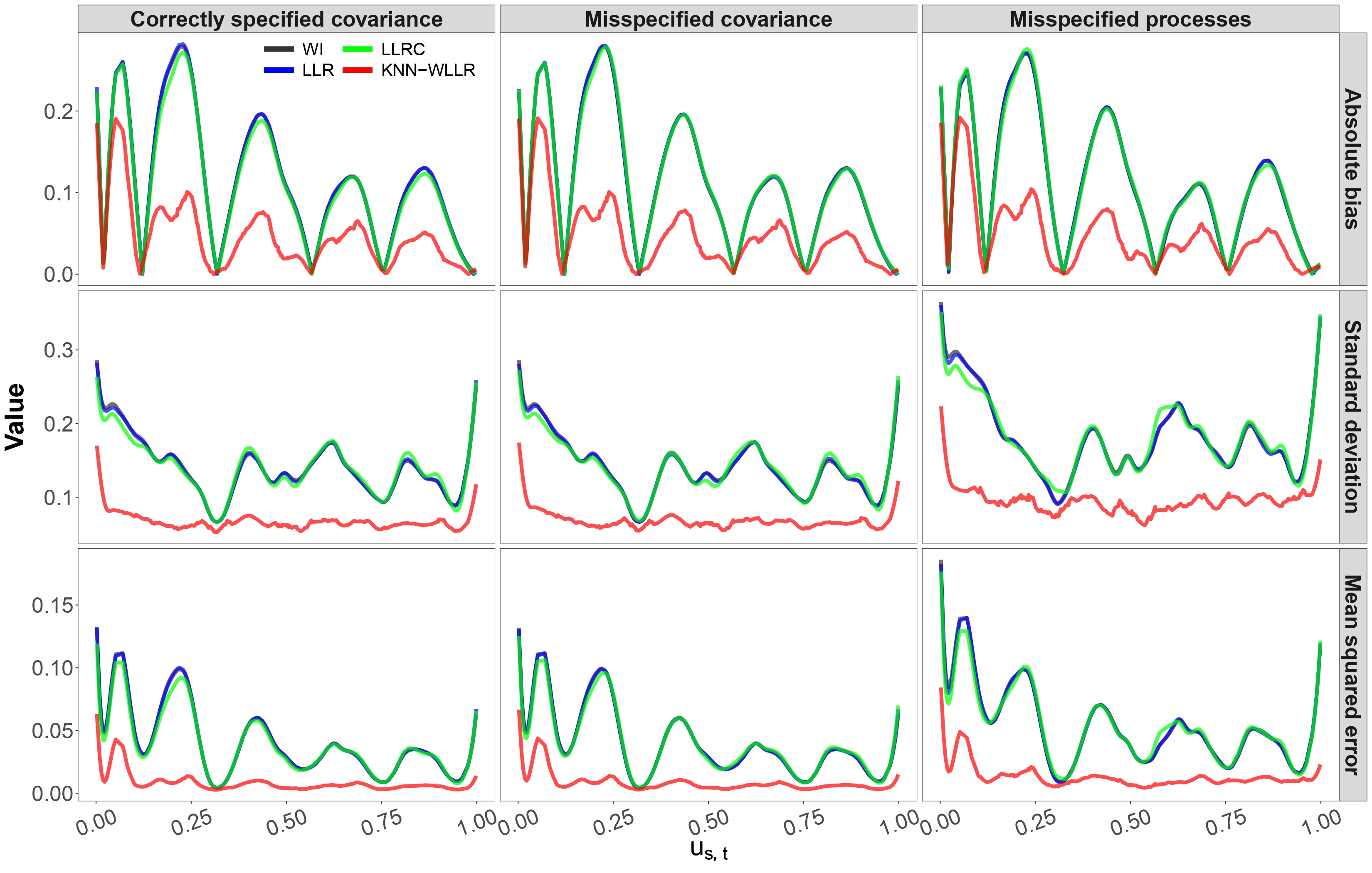
For spatiotemporally dependent data, the naive incorporation of complex dependence structures into nonparametric or semiparametric estimation procedures may lead to unreliable or undesirable inferences. As a result, many existing semiparametric approaches either completely ignore or inadequately account for spatiotemporal dependence during statistical inference, potentially resulting in efficiency losses and additional methodological challenges in improving prediction accuracy and interpretability. To address these issues, we propose a novel K-nearest-neighbor weighted local linear regression framework that properly incorporates spatiotemporal dependence into the estimation equations for both parametric and nonparametric components. In addition, the proposed approach does not require the assumption of non-stationarity of the space-time covariance, which makes the modeling more flexible. Under an increasing-domain asymptotic framework, we show that the bias and efficiency of the nonparametric estimator can be significantly improved, while the parametric counterpart achieves consistency and attains optimal efficiency under Gaussian settings. Simulation studies further demonstrate the finite-sample performance and robustness of the proposed methods, even when the covariance or data-generating process is misspecified. An application of air pollution data illustrates its practical effectiveness.
 |
 |
Recommended citation: Chen Y, Chu T, Zhou C, Shen Y, and Huang H. (2026). "Estimating semiparametric models for spatiotemporal data with complex dependence structures." Peer review.